
 By
By 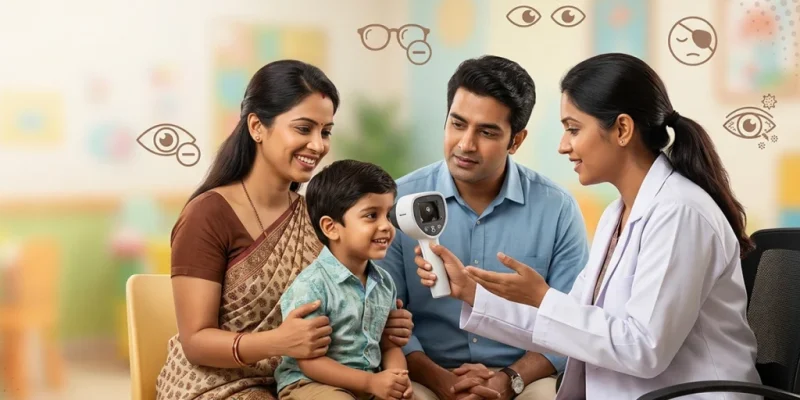
Myopia, or short-sightedness, usually makes distant objects appear blurred while nearer objects remain clearer. It commonly develops during childhood and can change as the eye grows. Research consistently associates greater time outdoors with a lower likelihood of developing myopia, although outdoor activity alone should not be presented as a complete treatment once a child is already myopic.
A child may not realise that their vision is different from anyone else’s. They may assume that a blurry classroom board, distant road sign, or television image looks the same to everyone.
For this reason, parents and teachers often notice behavioural clues before the child reports a problem.
1. Sitting unusually close to the television
A child with short-sightedness may move closer to a television or classroom screen because the image becomes clearer at a shorter distance.
Sitting close does not prove that a child has myopia. Habit, attention, hearing, or screen size can influence where a child sits.
However, a consistent need to move nearer to distant objects deserves attention.
2. Difficulty seeing the classroom board
School is often where myopia first becomes noticeable.
A child may copy notes incorrectly, ask to move to the front, depend on a friend to read distant text, or lose interest in lessons that rely heavily on board work.
This can sometimes be mistaken for poor concentration.
Vision should therefore be considered when school performance changes unexpectedly.
3. Frequent squinting
Squinting temporarily reduces the amount of scattered light entering the eye and may make distant objects appear slightly sharper.
A child who repeatedly narrows their eyes while watching television, reading road signs, or recognising people at a distance may need an eye check.
Persistent squinting can also occur for other reasons, so diagnosis should not be based on this sign alone.
4. Bringing books or devices very close
Children naturally hold some objects close, especially when drawing or playing games.
The concern is a noticeable change in behaviour or a consistently unusually short viewing distance.
Parents should also pay attention if the child says that text is clearer only when a phone or book is brought very near the face.
5. Frequent prescription changes
Myopia can progress while children and teenagers are growing.
If glasses repeatedly become inadequate within relatively short periods, the eye-care professional may need to evaluate how quickly the refractive error is changing.
The examination may include more than a standard glasses prescription. Depending on the child and the clinic, additional measurements may help monitor changes in the eye.
6. Headaches or visual tiredness
Headaches are not specific to myopia.
They may have many causes, including inadequate sleep, dehydration, stress, migraine, or other visual problems.
Nevertheless, headaches associated with schoolwork, difficulty seeing distant material, or repeated squinting should be mentioned during an eye examination.
7. Avoiding activities that require distance vision
Some children stop participating in ball sports, outdoor games, or other activities because they cannot clearly see what is happening at a distance.
They may appear uncoordinated simply because the ball, target, or other player is blurred.
A proper eye examination can help separate visual problems from coordination or attention issues.
Why outdoor time matters
Studies have repeatedly found that spending more time outdoors is associated with a lower risk of children developing myopia. A 2024 meta-analysis of randomised trials found that outdoor interventions reduced the incidence of myopia and produced modest differences in refractive and eye-length outcomes.
However, parents should not interpret this as meaning that outdoor play reverses established myopia.
An overview of systematic reviews found stronger evidence for outdoor time in reducing the development of myopia than for substantially slowing progression once myopia was already established.
Outdoor activity is therefore a healthy habit, not a substitute for prescribed glasses, monitoring, or professional treatment.
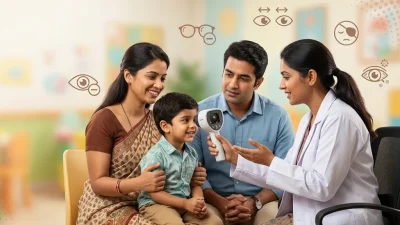
What happens during a children’s eye examination?
A proper children’s examination may assess:
- Distance and near vision
- Prescription in each eye
- Eye alignment
- Eye movements
- How the two eyes work together
- Focusing ability
- Front and back structures of the eyes
- Relevant family and medical history
Drops may sometimes be used to relax the eye’s focusing mechanism so the prescription can be measured more accurately.
Phiroze Dastoor’s children’s service states that its assessment includes visual clarity, eye-muscle coordination, binocular vision, and age-appropriate examination of the front and back of the eyes. It also discusses myopia monitoring and outdoor habits.
Parents concerned about changing distance vision can consider a children’s eye health assessment rather than relying only on whether the child complains of blur.
When should parents arrange an assessment?
Consider professional review when:
- A child repeatedly squints
- The child cannot see the classroom board clearly
- One eye appears to turn
- Glasses prescriptions change frequently
- The child reports double or distorted vision
- There is a strong family history of significant eye disease
- School screening identifies a problem
- One eye appears to see substantially worse than the other
Urgent assessment is required for sudden loss of vision, significant eye injury, a white-looking pupil, severe eye pain, or sudden abnormal eye movements.
Childhood vision problems are easier to manage when they are identified rather than ignored.
This article is intended for general education and does not replace a complete eye examination or personalised advice.








Comments